How Much Does a New AC Cost in Tucson?
Updated
What a quality installation starts at here, what is inside that price, and what a much lower number cannot contain.
If you have called around for a new air conditioner in Tucson, you have heard a wide spread of numbers and very little explanation of why they differ. This guide covers what a quality installation starts at in Tucson, what that price contains, and what a much lower one cannot contain. Read it whether you hire us or wait a year. You should be able to read any quote in Tucson and know what is inside it.
What a new system starts at in Tucson
A quality AC installation in the Tucson area starts around $10,500 for a 2- or 3-ton system and around $11,000 for a 4-ton system. That holds regardless of the brand on the box. Equipment is the easiest part of the job to shop for, and it is not what separates an installation that lasts from one that does not.
Those are floors, not quotes. A house with tight attic access, undersized returns, or ductwork that fails its test will land above them. The only way to get your real number is to have somebody measure the house and write it down, and a price given over the phone, before anyone has seen your home, is a guess.
Why the size changes the price
Tonnage is not a preference. It comes out of the load calculation — square footage, insulation, window area and orientation, ceiling height, how the ductwork is laid out. A bigger system means a larger coil and air handler, more refrigerant line, more air to move, and sometimes heavier electrical to feed it. That is why the 4-ton floor sits above the 2- and 3-ton floor, and it is also why nobody can tell you which one you need until the calculation is done.
Guessing here is expensive in both directions. Oversized equipment short-cycles, never pulls humidity out, and wears its compressor out early. Undersized equipment runs flat out through a Tucson July and still cannot keep the house cool in the afternoon.
What is inside the price
A quality installed price is a bundle of things, most of which you never see:
- A load calculation and a designed system — sized to the house, not copied off the tag on the old unit.
- A pre-measure visit before installation day, so the equipment fits and install day holds no surprises.
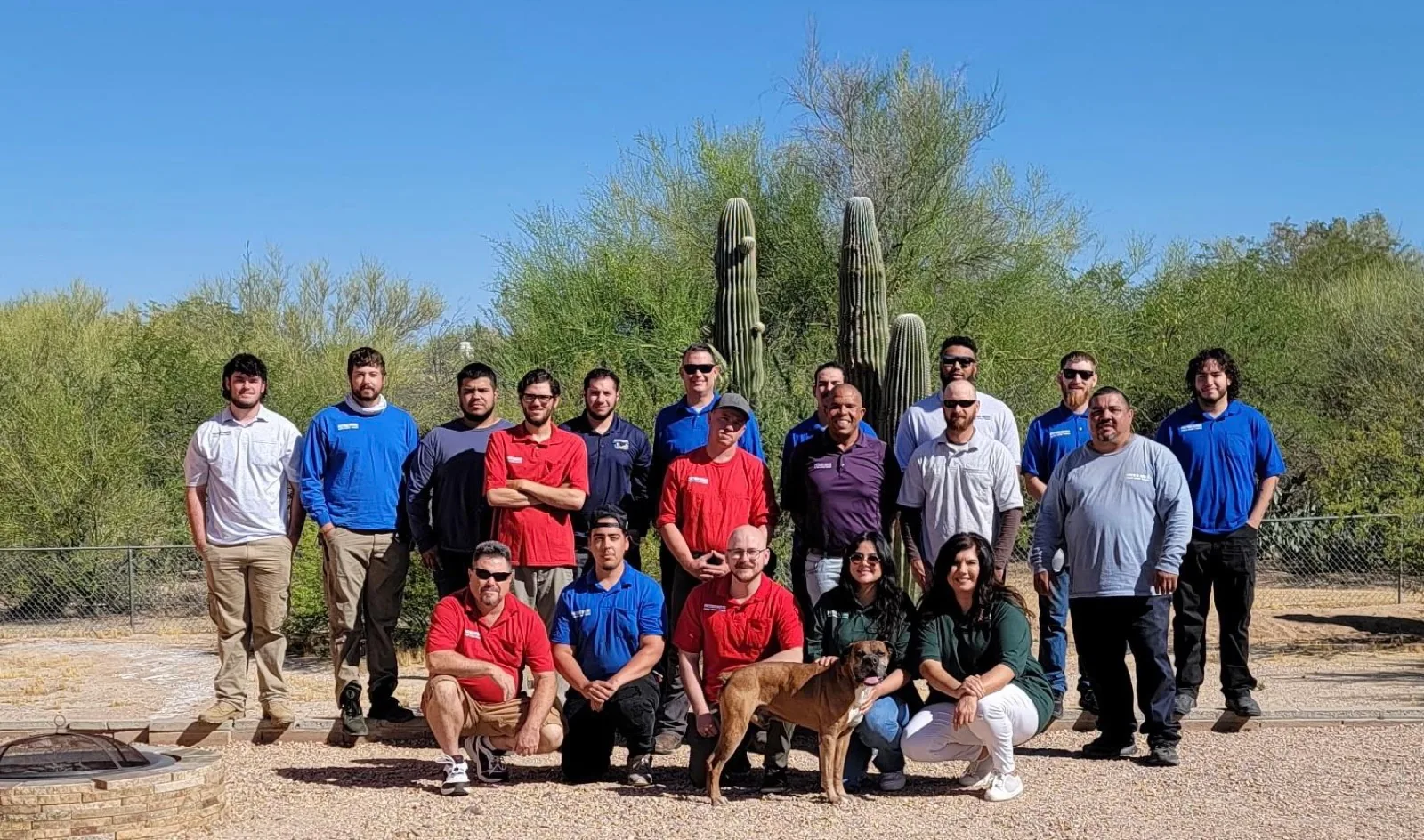
- The install crew who does the work.
- A quality-control visit after the install, once the system has been running.
- The parts around the unit — thermostat, pad, surge protector, disconnect, electrical whip, secondary safety switch, a high-rise pan when the install calls for one, and duct transitions into your existing ductwork. New equipment tied into old fittings is a common source of problems on an otherwise new system.
- Taxes.
- A written warranty.
- A maintenance plan.
- A written money-back guarantee on qualifying residential installations.
What a $7,000 to $8,000 number leaves out
Start with the exception: a ductless mini-split. A single-zone mini-split is a smaller job — no ducted system to transition, less equipment, less material — and $7,000 to $8,000 installed can be a complete, correct job. If that is what you are being quoted, the number is not the problem.
For a full ducted system replacement, that price covers the equipment and the labor to set it. The load calculation, the pre-measure, the code work on the electrical and the safety switch, and the quality-control visit after the install are not in it. They are still work that has to be done. Leaving them off the proposal does not take them out of the job — either they are in the price, or they are not in the job.
None of this is a statement about any particular company. It is what a number of that size can and cannot cover. And none of it shows on install day: a system that was never sized and never verified looks the same as one that was, right up until the first failure, or the day you sell the house and the home inspector goes through the system.
Six questions to ask before you sign
Ask these of every quote you get, including ours. The answers should be on paper.
- Who actually installs it? Ask who will be standing in the house.
- Is it sized for this house? Ask to see the load calculation. "Same as what you had" is not sizing; the old unit may have been wrong from the day it went in.
- Is it to code? Disconnect, whip, breaker and wire gauge, secondary safety switch, condensate handling — the parts that are code for a reason.
- Is it safe? Correct electrical, proper clearances, and on a gas system, the combustion and venting side checked rather than assumed.
- Will it pass a home inspection when you sell? A buyer's inspector goes through the system, and work that was never done right has a way of surfacing at the closing table. It is a much more expensive problem then.
- Who comes back if it fails? In writing: what is covered, for how long, and who you call. Get it in writing — a verbal promise is not coverage.
Who we are
We are a family-owned, multi-generation business, and we have been serving Tucson since 2001 — 25 years. There is no private-equity owner, no outside investors, and no plan to sell. The owners work in the business, and they will still be here when your warranty needs using.
How we do the work — what gets measured on a repair, what gets verified on an install, which licenses the work is done under — is written out on our workmanship standards page, and the coverage that follows it is on our repair and service warranty page.
We would like to install your system. We also want you to be able to read any quote in Tucson and tell what is in it.
Get your number in writing
Call us at (520) 655-8551 or book online and we will measure the home, run the load calculation and put a real number in writing — one that includes the verification and the written guarantee. If you would rather read first, the full process is on our AC installation page.